
85 scored questions spread over 116 outline topics — and the flattest weighting of any part of the exam. Twelve topics tie for first place. We mapped every topic in the IRS Content Outline against the domain weights the IRS publishes.
Most people study for Part 2 of the Enrolled Agent (EA) exam entity by entity — partnerships one week, corporations the next, S corporations after that. It is a tidy plan, and it puts the business return itself last. The IRS publishes enough to show that the return is where most of the questions are.
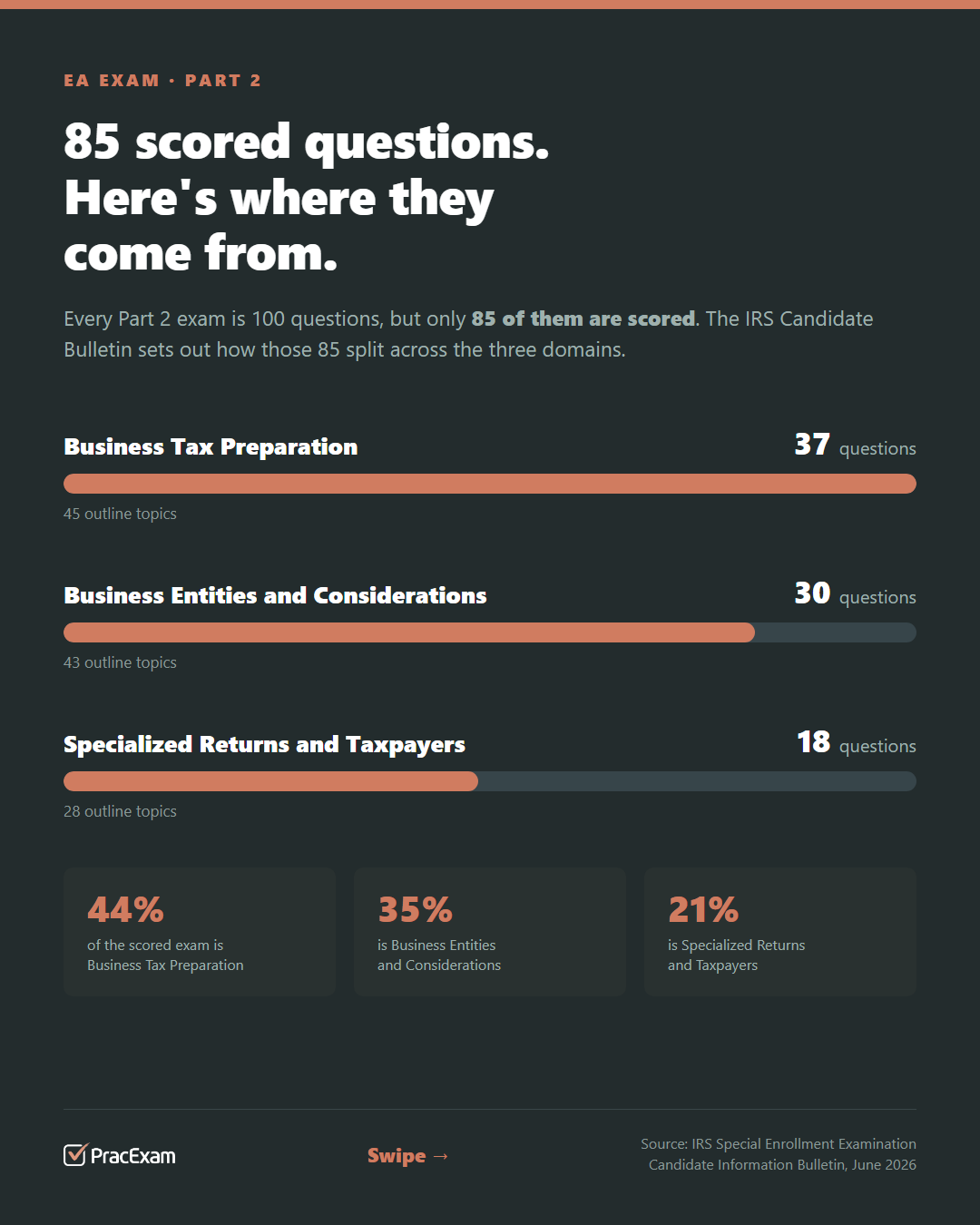
Every Part 2 exam is 100 questions, but only 85 of them are scored. The other 15 are experimental items the IRS is trying out for future exams, and you are never told which is which. The Candidate Bulletin sets out how those 85 split across the three domains.
Business Tax Preparation leads with 37 questions — 44% of the scored exam in one domain. Business Entities and Considerations follows with 30, and Specialized Returns and Taxpayers with 18.
Part 2 has only three domains, against six on Part 1 and four on Part 3. Fewer buckets means each one is large, and it is tempting to read that as a simple ranking. The second number is what changes the plan.
The Content Outline breaks every domain into named topics: 116 of them across Part 2. Business Tax Preparation carries its 37 questions in 45 topics. Specialized Returns and Taxpayers spreads 18 questions over 28.
That is 0.82 questions per topic against 0.64 — about a third more for the same hour of reading. On Part 1 the same comparison is three to one, and on Part 3 it is nearly two to one. Part 2 is the flattest part of the exam.
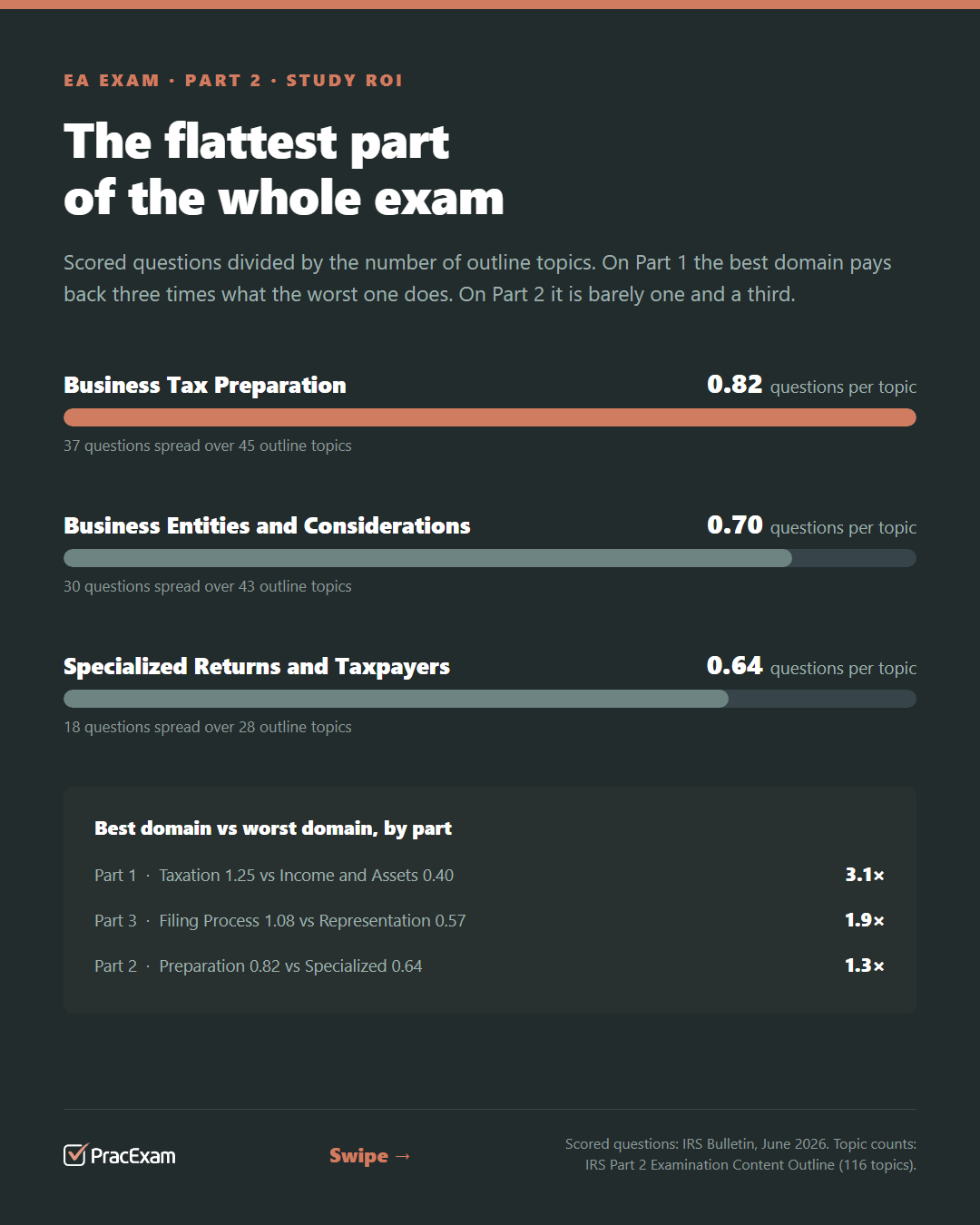
| Domain | Scored questions | Outline topics | Per topic |
|---|---|---|---|
| Business Tax Preparation | 37 | 45 | 0.82 |
| Business Entities and Considerations | 30 | 43 | 0.70 |
| Specialized Returns and Taxpayers | 18 | 28 | 0.64 |
On Part 1 an hour spent in the right domain is worth three somewhere else. On Part 2 it is worth about a third more. There is no shortcut on this part — only coverage.
Rank all 116 topics by expected questions and there is no leader. On Part 1 the top topic is worth about 2.2 questions and on Part 3 about 2.0. On Part 2 the top figure is 1.1, and twelve topics share it — every one of them a Business Tax Preparation topic.
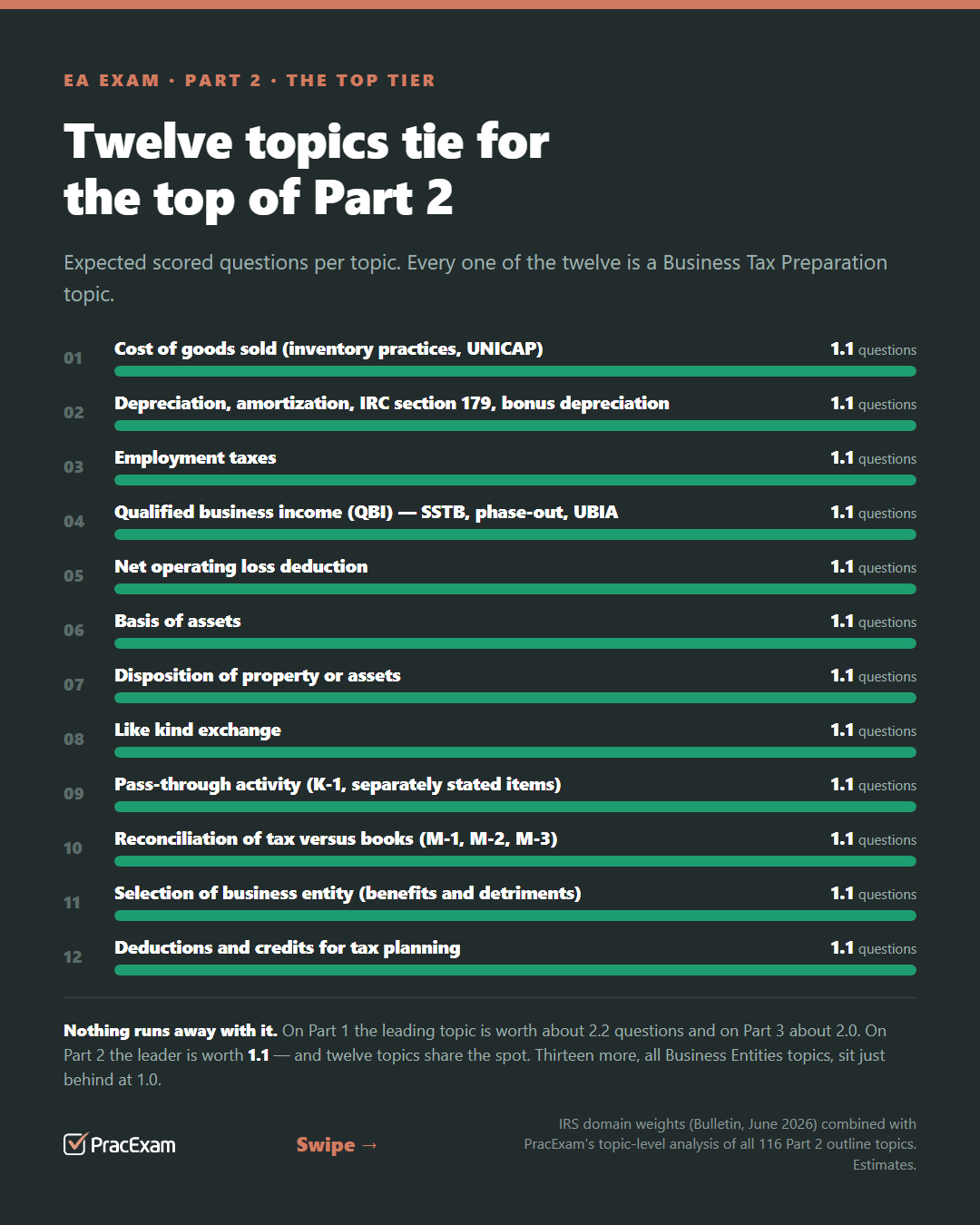
The twelve are the mechanics of the business return itself: cost of goods sold, depreciation and IRC section 179, employment taxes, qualified business income, the net operating loss deduction, basis of assets, dispositions, like kind exchange, pass-through activity, the book-to-tax reconciliation, entity selection, and deductions and credits for tax planning. Thirteen more topics sit just behind at 1.0, and all thirteen are Business Entities topics — partnership and S corporation basis, distributions, flow-through, IRC section 351, earnings and profits.
Those twenty-five topics together are worth about 26 of the 85 scored questions — 31% of the exam from 22% of the outline. That is a real edge, but it is a much thinner one than Part 1 or Part 3 offers, and it runs out quickly. The remaining 91 topics still carry 59 questions between them.
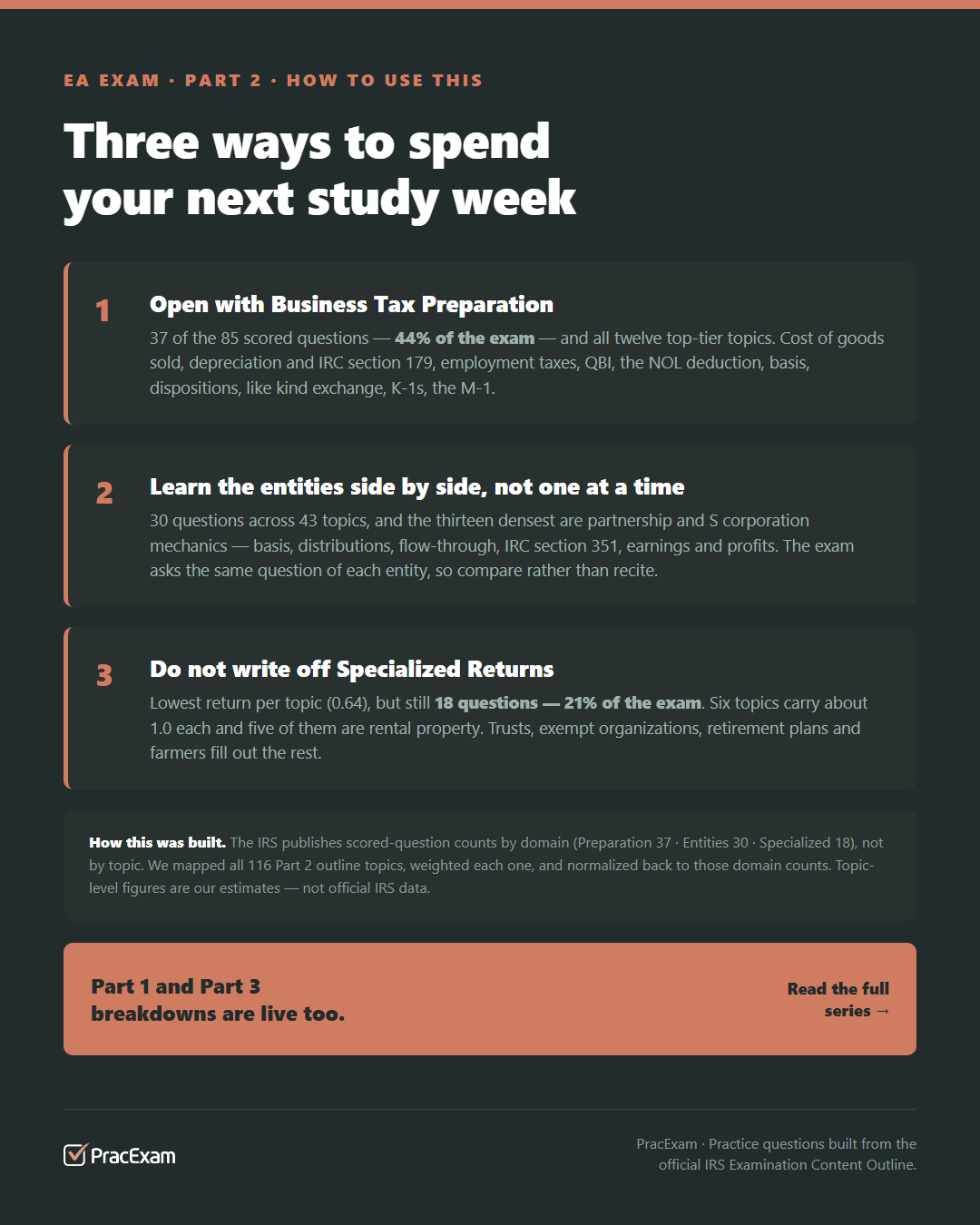
Open with Business Tax Preparation. Forty-five outline topics carry 37 questions, and all twelve of the top-tier topics sit here. If you learn nothing else well, learn cost of goods sold, depreciation and IRC section 179, employment taxes, QBI, and basis.
Learn the entities side by side, not one at a time. Thirty questions across 43 topics, and the thirteen densest are the same handful of questions asked of each entity — how basis is computed, how distributions are taxed, what flows through. Studying partnerships and S corporations in parallel covers both faster than studying them in sequence.
Do not write off Specialized Returns. It has the lowest return per topic on the part, and it is still 18 questions — 21% of the exam. Six of its topics carry about 1.0 each, and five of those six are rental property. Trusts, exempt organizations, retirement plans and farmers fill out the rest.
Questions can come from any topic on the outline. These weights tell you where to put the hour you have left over — not where to stop reading. On a part this flat that warning carries more weight than usual: the twelve topics at the top are worth about 13 questions, and the passing line is well above that.
The 15 experimental questions matter here too. They are unscored, they are not marked, and they can come from anywhere. If you meet a question that looks like nothing you have ever seen, it may not count at all. The useful response is to answer it and move on — not to lose the next ten minutes to it.
The IRS publishes scored-question counts by domain, not by topic. The topic-level figures here are PracExam estimates — every topic in the official Content Outline weighted and normalized back to the official domain counts. Sources: IRS Special Enrollment Examination Candidate Information Bulletin (June 2026) and the IRS Part 2 Examination Content Outline.
5,000+ EA questions built from the official Content Outline. Smart (TPIQ) mode orders them by exactly this weighting, so the heavily tested topics come up first. Five free questions every day for 30 days — no card needed.