
85 scored questions spread over 120 outline topics — and Filing Process, the smallest domain, pays back almost twice what Representation before the IRS does. We mapped every topic in the IRS Content Outline against the domain weights the IRS publishes.
Most people study for Part 3 of the Enrolled Agent (EA) exam by treating every rule in Circular 230 as equally likely to show up. It is a fair plan, and it treats every page as though it were worth the same. The IRS publishes enough to show that it is not.
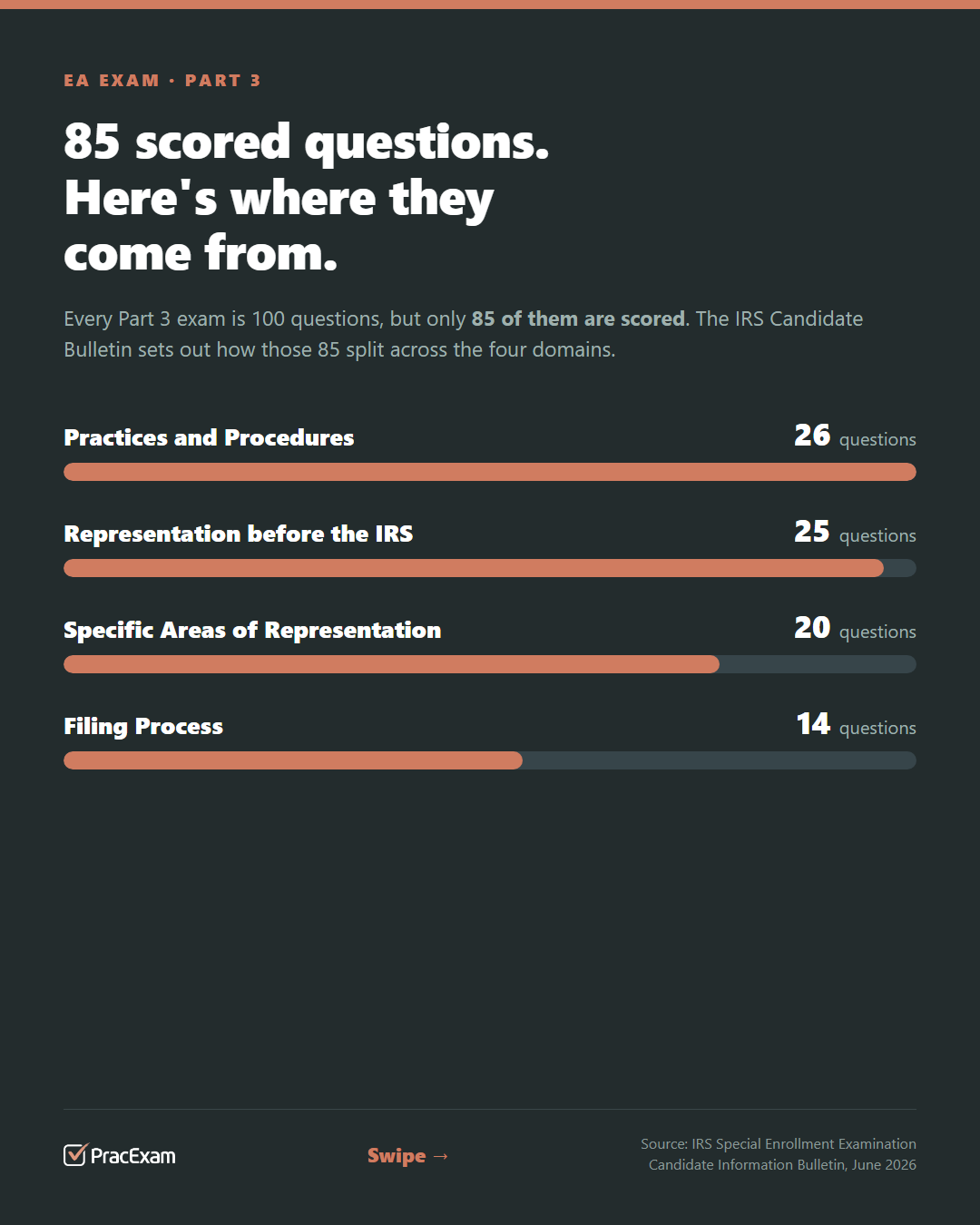
Every Part 3 exam is 100 questions, but only 85 of them are scored. The other 15 are experimental items the IRS is trying out for future exams, and you are never told which is which. The Candidate Bulletin sets out how those 85 split across the four domains.
Practices and Procedures leads with 26 questions, followed by Representation before the IRS with 25, Specific Areas of Representation with 20, and Filing Process with 14.
Read that list on its own and you would give your first week to Practices and Procedures, simply because it carries the most questions. That would leave the smallest domain almost untouched — and that would be a mistake.
The Content Outline breaks every domain into named topics: 120 of them across Part 3. They are not spread evenly. Filing Process packs its 14 questions into just 13 topics. Representation before the IRS spreads 25 questions over 44.
That is 1.08 questions per topic for Filing Process against 0.57 for Representation before the IRS — almost twice the return on the same hour of reading. Specific Areas of Representation, also at 0.57, lands close enough to Representation to call it a tie.
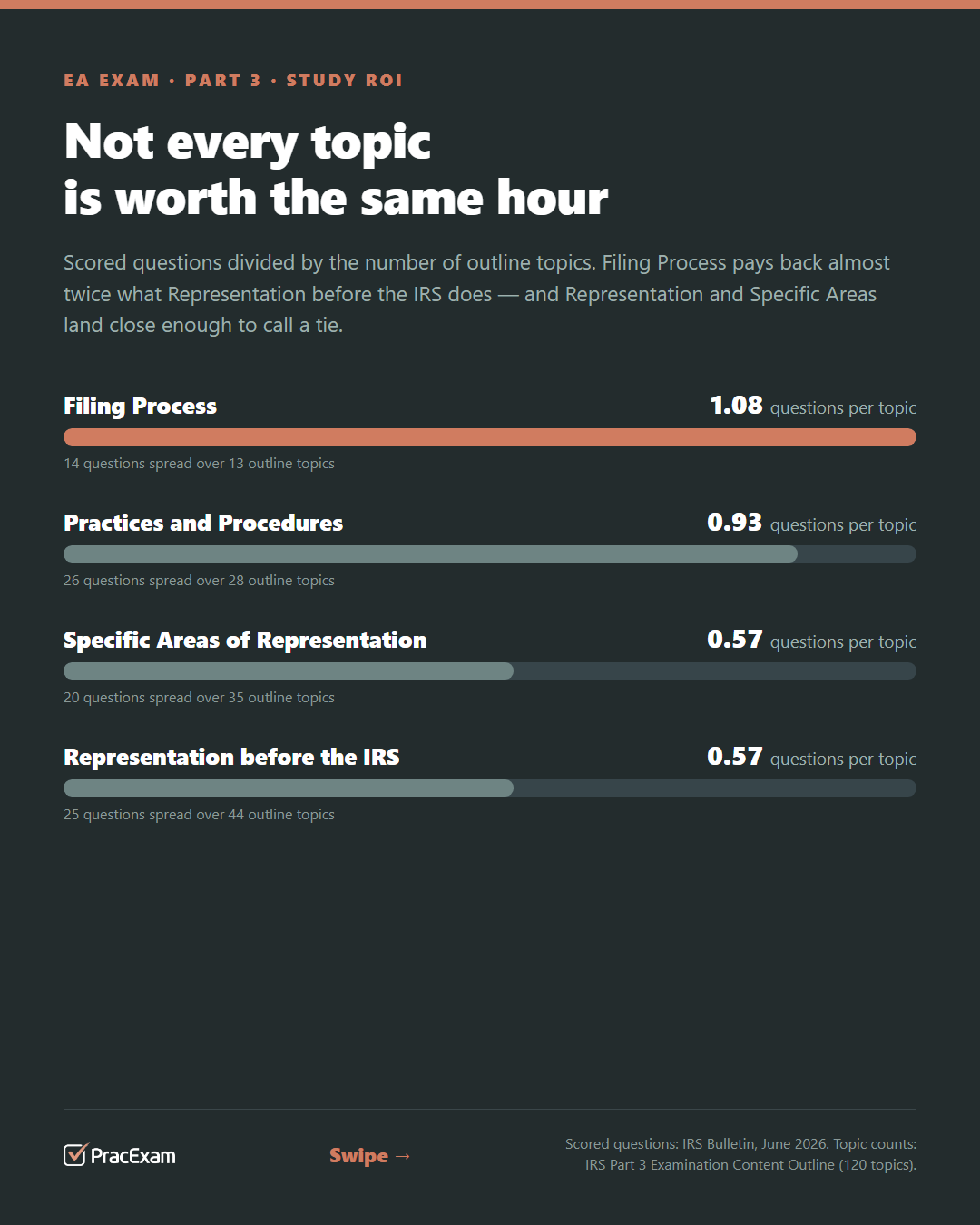
| Domain | Scored questions | Outline topics | Per topic |
|---|---|---|---|
| Filing Process | 14 | 13 | 1.08 |
| Practices and Procedures | 26 | 28 | 0.93 |
| Specific Areas of Representation | 20 | 35 | 0.57 |
| Representation before the IRS | 25 | 44 | 0.57 |
An hour on Filing Process is worth about twice an hour on Representation before the IRS — measured in questions you are actually likely to see.
Rank all 120 topics by expected questions and one topic stands alone at the top: e-file authorization and supporting documentation — Form 8879 and Form 8453 — worth roughly 2.0 questions. Everything else in the top 15 clusters at about 1.4.
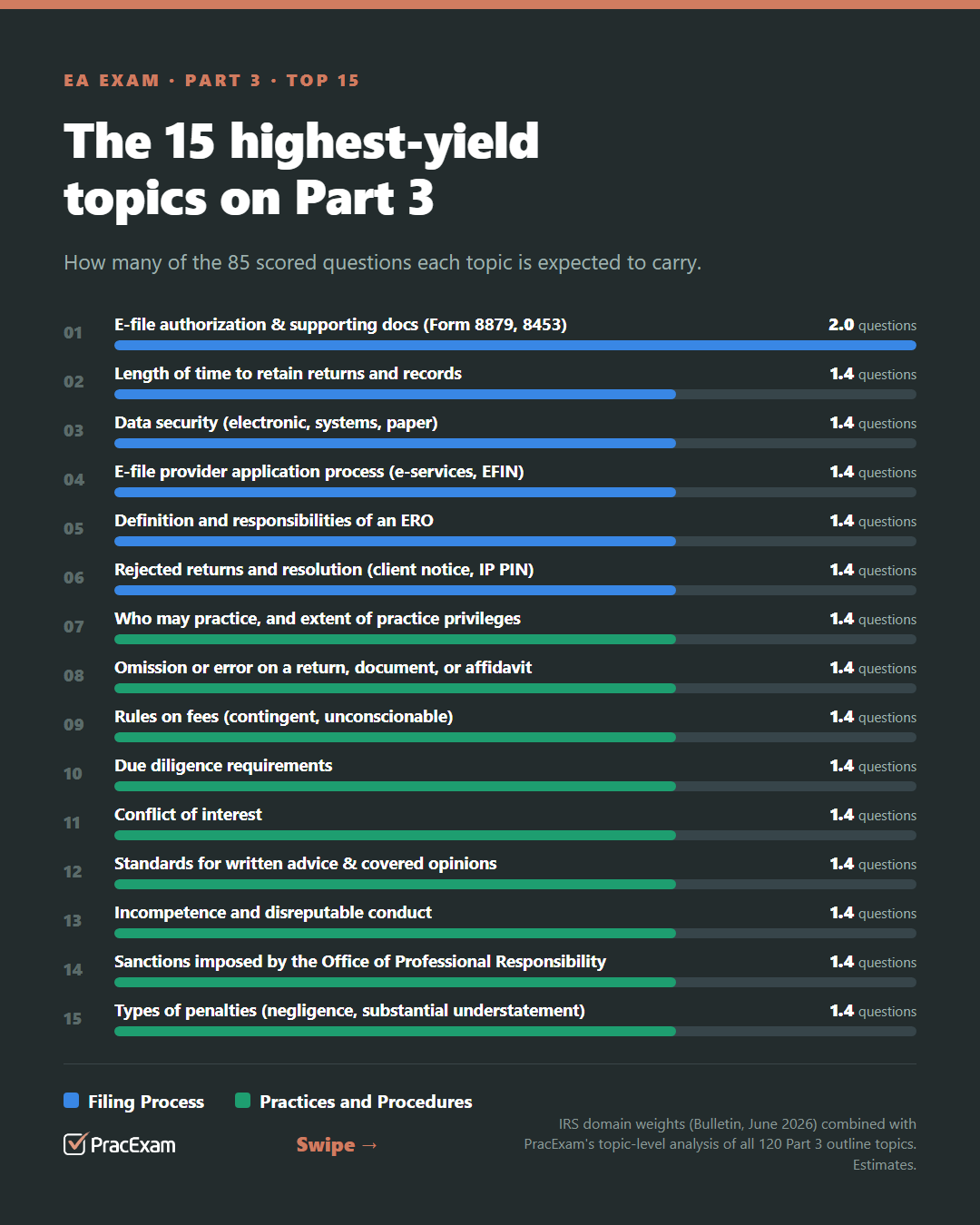
That cluster splits cleanly along domain lines. Six of the top fifteen are Filing Process topics — retention of returns and records, data security, the e-file provider application process, the ERO’s responsibilities, and rejected-return resolution, alongside the Form 8879/8453 leader. The other nine are Practices and Procedures topics: who may practice, due diligence, conflict of interest, fee rules, written-advice standards, incompetence and disreputable conduct, OPR sanctions, and the types of preparer penalties.
That is the real trap here. Representation before the IRS and Specific Areas of Representation do not place a single topic in the top 15. Does that mean you can skim them? Not at all — together they carry 45 of the 85 scored questions, 53% of the exam.
Treating that half of the exam as a pile of minor rules just because none of its topics top the chart is the most common, most expensive mistake on Part 3. Dig deep where it counts, but a broad, even pass over these domains — half the test — is what separates a pass from a fail.
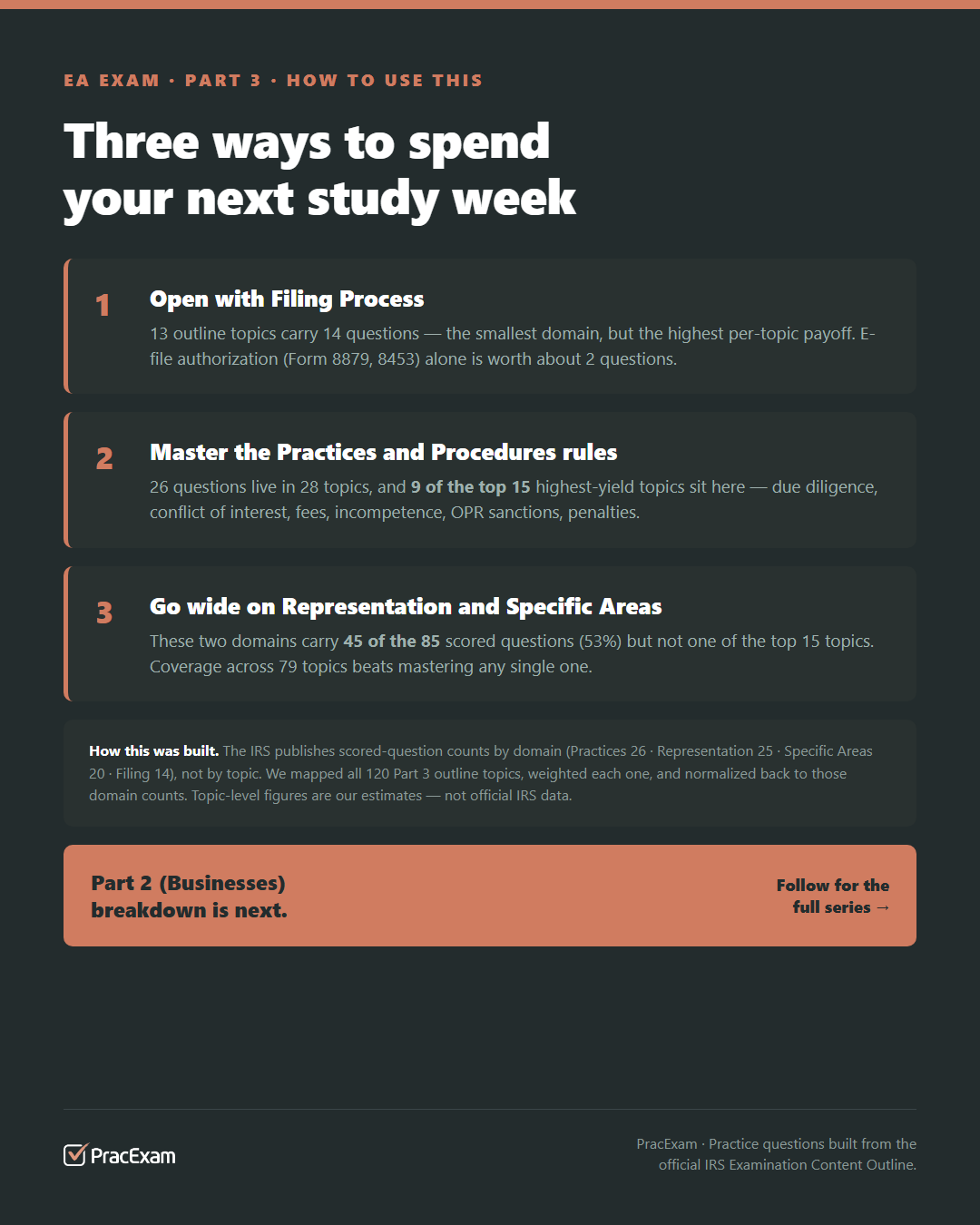
Open with Filing Process. Thirteen outline topics carry 14 questions — the highest return per topic on the exam. E-file authorization alone (Form 8879, Form 8453) is worth about 2 questions by itself.
Master the Practices and Procedures rules. Twenty-six questions live in 28 topics, and nine of the fifteen densest topics on the exam sit here — due diligence, conflict of interest, fee rules, incompetence and disreputable conduct, OPR sanctions, and the penalty categories.
Go wide on Representation and Specific Areas of Representation, not deep. These two domains share 45 of the 85 questions across 79 topics, and neither produces a single top-15 topic. Knowing what each topic covers serves you better than mastering any one of them.
Questions can come from any topic on the outline. These weights tell you where to put the hour you have left over — not where to stop reading. Anyone who studies only the top fifteen topics has prepared for about a quarter of the scored exam.
The 15 experimental questions matter here too. They are unscored, they are not marked, and they can come from anywhere. If you meet a question that looks like nothing you have ever seen, it may not count at all. The useful response is to answer it and move on — not to lose the next ten minutes to it.
The IRS publishes scored-question counts by domain, not by topic. The topic-level figures here are PracExam estimates — every topic in the official Content Outline weighted and normalized back to the official domain counts. Sources: IRS Special Enrollment Examination Candidate Information Bulletin (June 2026) and the IRS Part 3 Examination Content Outline.
5,000+ EA questions built from the official Content Outline. Smart (TPIQ) mode orders them by exactly this weighting, so the heavily tested topics come up first. Five free questions every day for 30 days — no card needed.