
85 scored questions spread over 117 outline topics — and a three-to-one gap in what an hour of study buys you. We mapped every topic in the IRS Content Outline against the domain weights the IRS publishes.
Most people study for Part 1 of the Enrolled Agent (EA) exam by opening the book at page one and working forward. It is a fair plan, and it treats every page as though it were worth the same. The IRS publishes enough to show that it is not.
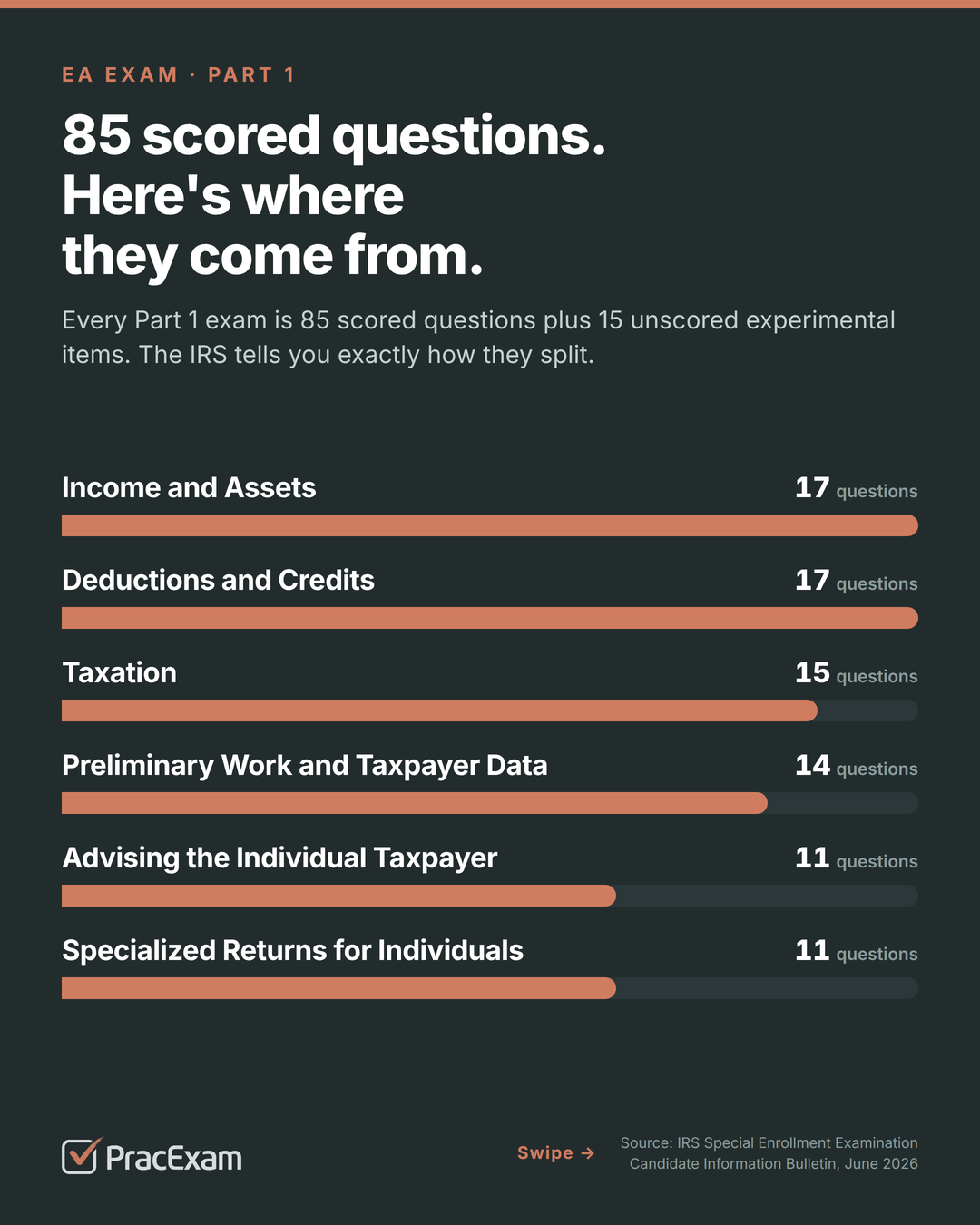
Every Part 1 exam is 100 questions, but only 85 of them are scored. The other 15 are experimental items the IRS is trying out for future exams, and you are never told which is which. The Candidate Bulletin sets out how those 85 split across the six domains.
Income and Assets and Deductions and Credits tie at the top with 17 questions each. Taxation follows with 15, Preliminary Work and Taxpayer Data with 14, and both Advising the Individual Taxpayer and Specialized Returns for Individuals with 11.
Read that list on its own and you would give your first week to Income and Assets. That would be a mistake — and the reason is the second number.
The Content Outline breaks every domain into named topics: 117 of them across Part 1. They are not spread evenly. Income and Assets stretches its 17 questions over 43 separate topics. Taxation packs 15 questions into 12.
That is 0.40 questions per topic for Income and Assets against 1.25 for Taxation — a little over three times the return on the same hour of reading.
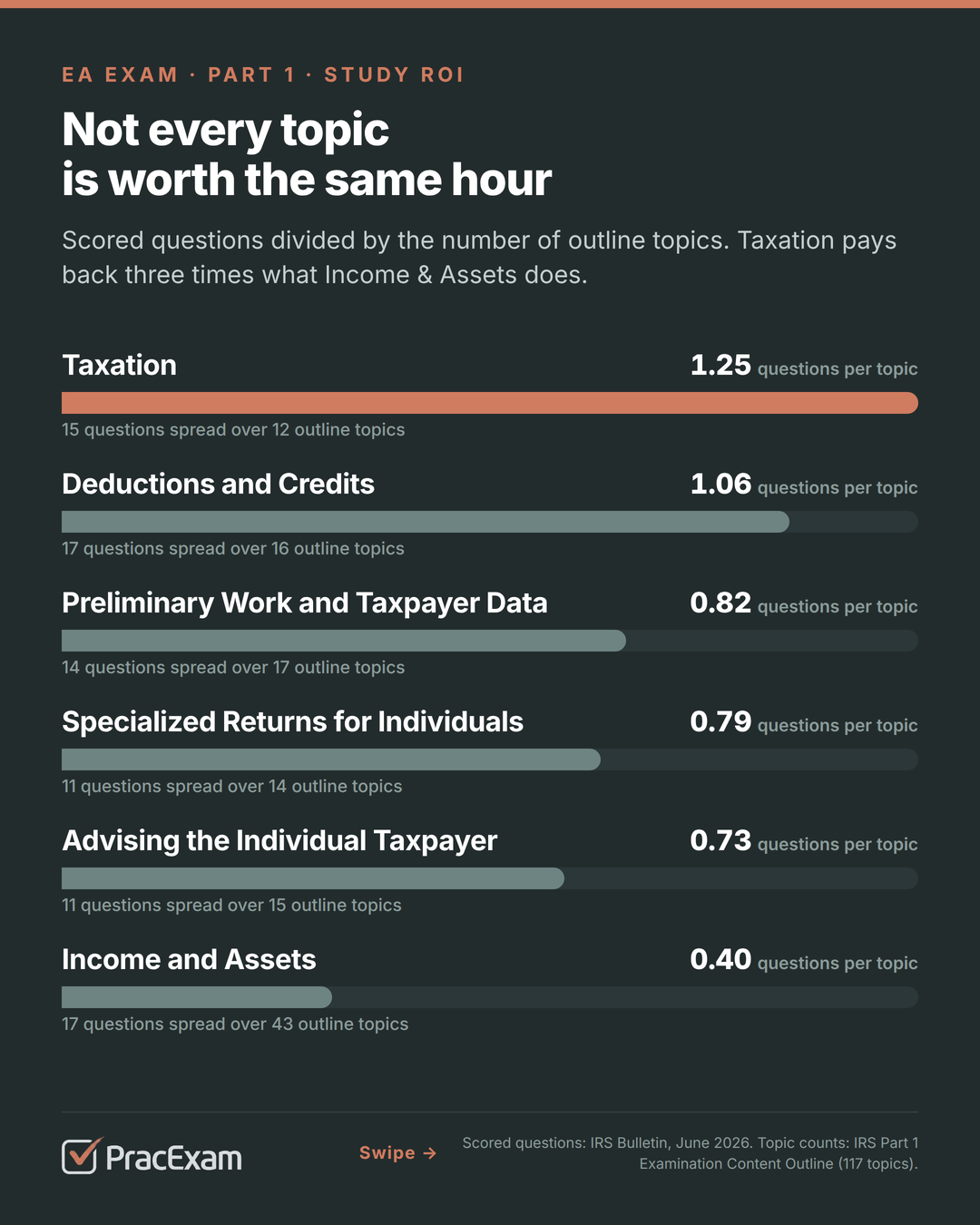
| Domain | Scored questions | Outline topics | Per topic |
|---|---|---|---|
| Taxation | 15 | 12 | 1.25 |
| Deductions and Credits | 17 | 16 | 1.06 |
| Preliminary Work and Taxpayer Data | 14 | 17 | 0.82 |
| Specialized Returns for Individuals | 11 | 14 | 0.79 |
| Advising the Individual Taxpayer | 11 | 15 | 0.73 |
| Income and Assets | 17 | 43 | 0.40 |
An hour on Taxation is worth about three on Income and Assets — measured in questions you are actually likely to see.
Rank all 117 topics by expected questions and the top of the list is narrow. Self-employment tax and the net investment income tax lead at roughly 2.2 questions each. Alternative minimum tax, underpayment penalties and interest, tax provisions for military members, and the additional Medicare tax follow at about 1.5.
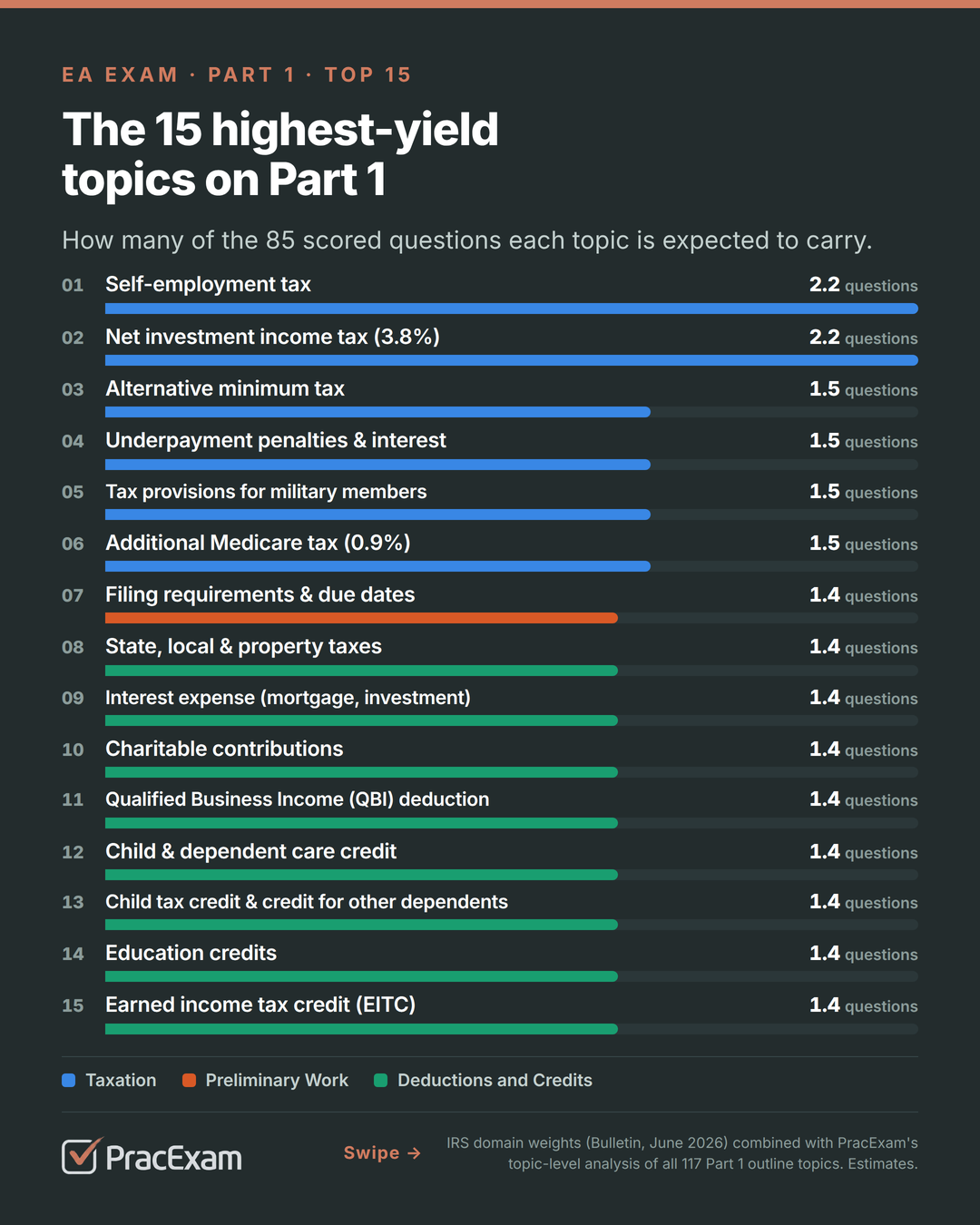
What fills the rest of the list is the useful part. Eight of the top fifteen are Deductions and Credits topics — state, local and property taxes; interest expense; charitable contributions; the QBI deduction; the child and dependent care credit; the child tax credit; education credits; and the earned income tax credit. Six are Taxation topics. Exactly one — filing requirements and due dates — comes from Preliminary Work.
Deductions and Credits does not lead the per-topic table, yet it owns more of the highest-yield topics than any other domain. Skipping the credits because everybody knows the credits is the most expensive shortcut available on Part 1.
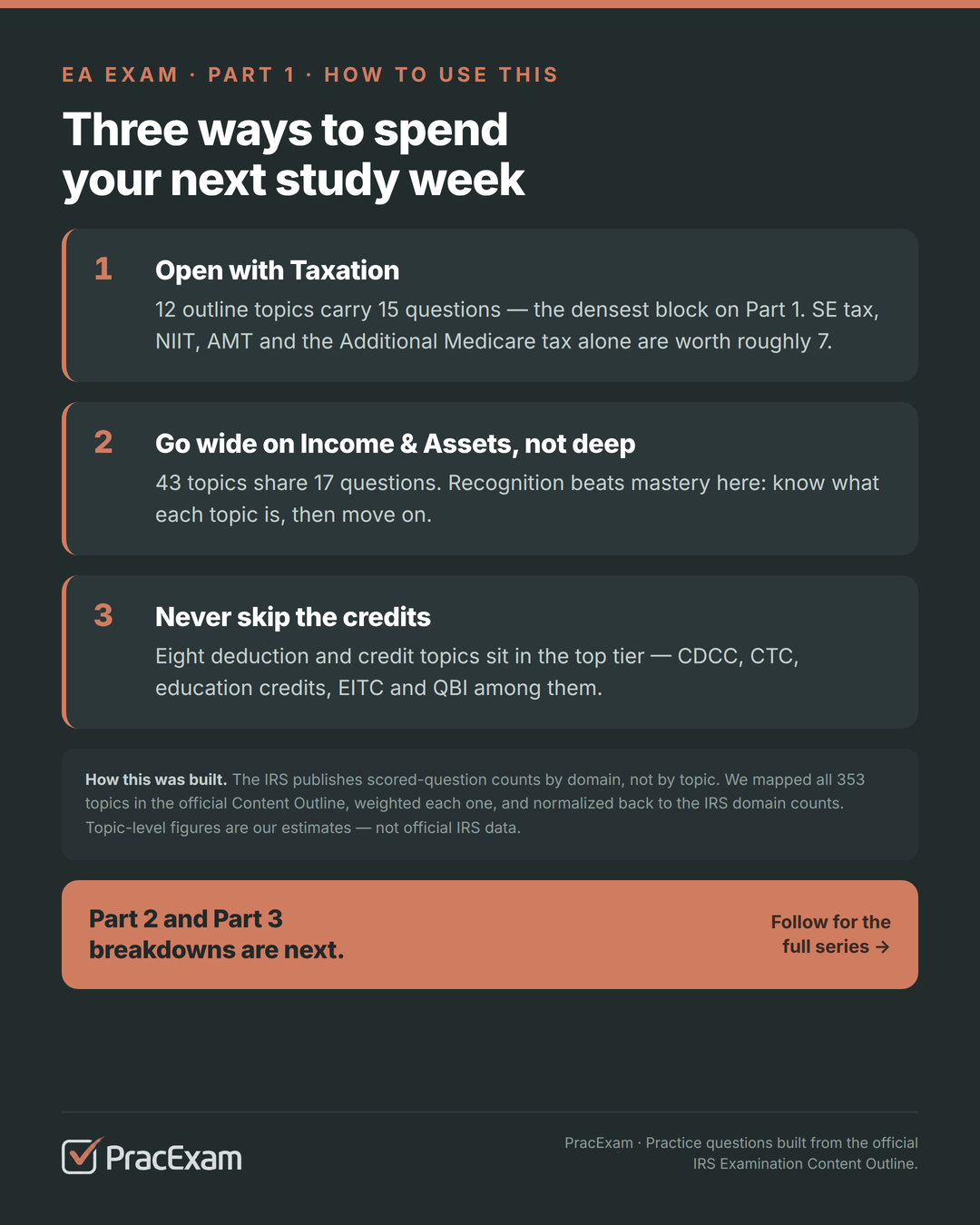
Open with Taxation. Twelve outline topics carry 15 questions — the densest block on the exam. Self-employment tax, NIIT, AMT and the additional Medicare tax are worth roughly seven questions between them.
Go wide on Income and Assets, not deep. With 43 topics sharing 17 questions, knowing what each topic covers serves you better than mastering any single one of them.
Never skip the credits. Eight of the fifteen densest topics sit there, and they are the ones candidates assume they already have.
Questions can come from any topic on the outline. These weights tell you where to put the hour you have left over — not where to stop reading. Anyone who studies only the top fifteen topics has prepared for about a quarter of the scored exam.
The 15 experimental questions matter here too. They are unscored, they are not marked, and they can come from anywhere. If you meet a question that looks like nothing you have ever seen, it may not count at all. The useful response is to answer it and move on — not to lose the next ten minutes to it.
The IRS publishes scored-question counts by domain, not by topic. The topic-level figures here are PracExam estimates — every topic in the official Content Outline weighted and normalized back to the official domain counts. Sources: IRS Special Enrollment Examination Candidate Information Bulletin (June 2026) and the IRS Examination Content Outline.
5,000+ EA questions built from the official Content Outline. Smart (TPIQ) mode orders them by exactly this weighting, so the heavily tested topics come up first. Five free questions every day for 30 days — no card needed.